Cross-Border commercial contracts are agreements between parties that are based in different countries to conduct trade, provide services, or make investments. These contracts are common in international trade, outsourcing, technology transfers, and foreign investments. While these contracts help in the global expansion of businesses, they also involve various legal risks that are not present in domestic contracts. Differences in legal systems, judicial approaches, procedural rules, and enforcement mechanisms often create uncertainty and increase the likelihood of disputes. The most important legal risks in cross-border commercial contracts are related to governing law, jurisdiction, and enforcement issues. If these aspects are not considered properly, even a commercially sound agreement may become difficult to enforce. Understanding these issues helps the parties to protect their interests and avoid future conflicts.
1. Governing Law:
The governing law of a contract determines which country’s laws will apply to interpret the contract and decide disputes. In cross-border contracts, parties are subject to different legal systems, each having its own principles, remedies, and standards of interpretation. If a contract fails to mention the governing law, the court decides it using ‘conflict of law’ rules. This often leads to uncertainty because different courts may have different conclusions.
Even if the governing law is decided, risks may still arise if:
- The law is unfamiliar to one or both parties
- The law conflicts with the public policy of the forum court
- The law has mandatory rules that override contractual terms
Disputes may arise if a contract governed by a foreign law includes clauses that are valid under that law but unenforceable in another jurisdiction due to statutory prohibitions or public concerns.
While party autonomy is widely recognized in cross-border commercial contracts, it is not absolute. Courts may refuse to apply the chosen governing law if it violates mandatory local laws, consumer protection statutes, competition law, or public policy. This limitation poses a serious legal risk, especially when the contracts affect public interests.
2. Jurisdiction:
Jurisdiction refers to the authority of a court or tribunal to hear a dispute. In cross-border contracts, more than one country’s courts may have jurisdiction, such as the courts where the contract was formed, performed, or the residence of the parties. This itself is a source of legal risk. A jurisdiction clause aims to avoid uncertainty by specifying the dispute resolution forum. It may grant jurisdiction to a particular court or allow the parties to choose from all the available forums.
If the jurisdiction clause does not exist, either party may approach any court that is favorable to them, even if it is unfair to the other. This can result in parallel proceedings in different countries, leading to increased cost and inconsistent judgments. Such disputes can lead to a delay in dispute resolution and hinder the commercial purpose of the contract.
To avoid jurisdiction-related problems, many cross-border contracts prefer arbitration. Arbitration allows parties to resolve disputes through a neutral process instead of unfamiliar national courts. However, arbitration clauses must be drafted carefully because poorly drafted clauses can result in disputes over the validity and applicability of arbitration.
3. Enforcement:
A favorable judgment or arbitral award is only valuable if it can be enforced. In cross-border contracts, enforcement is often the most critical and challenging stage. Differences in national enforcement laws, procedural requirements, and judicial attitudes can significantly affect outcomes. Courts do not automatically enforce judgments passed by the foreign courts. Local laws, international agreements and principles like fairness and public policy influence the enforcement of judgments. A court may refuse enforcement if it believes that the foreign court lacked jurisdiction, the procedure was unfair, or the judgment goes against public policy.
This creates a major risk when the losing party’s assets are located in a country that does not recognize foreign judgments.
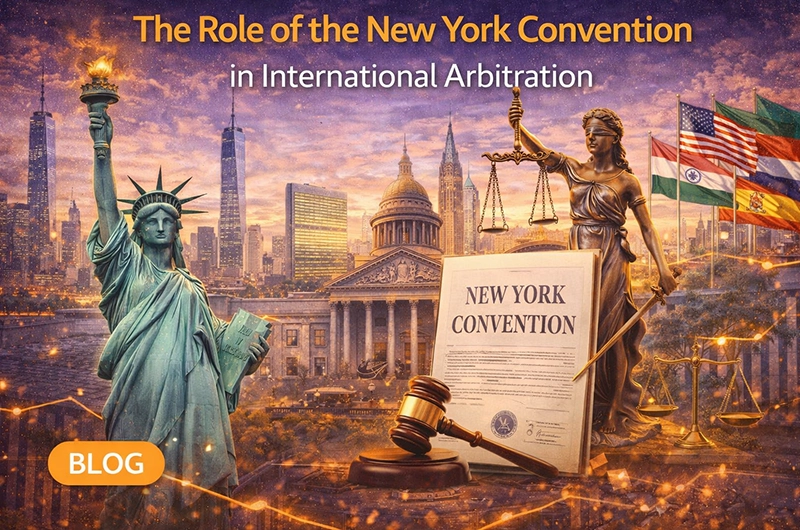
Arbitral awards are generally easier to enforce across borders than court judgments. Many countries recognize foreign arbitral awards under international conventions. However, enforcement can still be refused in limited situations, such as when the arbitration agreement is invalid or the award violates public policy. Thus, while arbitration reduces enforcement risks, it does not eliminate them.
These three aspects are closely interconnected. A poorly chosen government law may affect the validity of a jurisdiction or arbitration clause. Similarly, a favorable forum may still be ineffective if enforcement is difficult in the country where the assets are located. Choosing a neutral governing law, a reliable dispute resolution forum, and a jurisdiction with strong enforcement mechanisms significantly enhances legal certainty and commercial confidence. Therefore, parties must think about governing law, jurisdiction, and enforcement together while drafting cross-border contracts.
Cross-border commercial contracts offer great business opportunities but also involve legal risks due to differences in national legal systems. These risks can transform commercial disputes into prolonged and costly legal battles if not addressed carefully at the drafting stage. These risks can be reduced through clear and careful drafting of contract clauses. By choosing an appropriate governing law, specifying dispute resolution mechanisms, and considering enforcement possibilities in advance, parties can avoid unnecessary disputes and ensure smoother international business relationships.

Hritvik Gupta is a legal writer and researcher associated with LEGALLANDS LLP, where he contributes analytical and research-driven articles on corporate governance, international trade laws, and policy reforms. His writing reflects a deep understanding of evolving legal frameworks and their impact on cross-border commerce and regulatory compliance.
Hritvik’s work bridges practical legal insight with emerging global regulatory trends, offering readers a balanced perspective that combines academic depth with real-world application. He takes a keen interest in the intersection of law, technology, and international policy, contributing to the discourse on how businesses and governments can adapt to dynamic legal environments.
Through his contributions to Legallands.com, Hritvik aims to make complex legal developments more accessible, insightful, and relevant to businesses, professionals, and policymakers operating in an increasingly interconnected world.